Graduate Work

My defense on November 6, 2017. The presentation was titled "Creation and Characterization of an Emotional Speech Database"
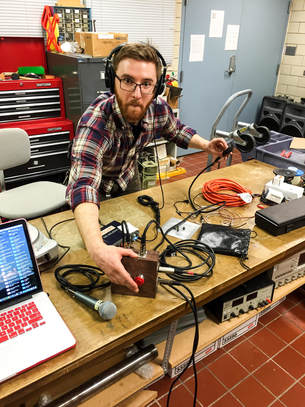
Master of Science in AcousticsMy research in acoustics was done as part of the Sound Perception and Room Acoustics Laboratory (SPRAL) lead by Dr. Michelle Vigeant. Our work was a collaboration between the Graduate Program in Acoustics and Cognitive Psychology. My responsibilities were to generate a corpus of emotional speech and analyze its acoustical content using DSP techniques in MATLAB.
|

The Sound Perception and Room Acoustics Laboratory (SPRAL)SPRAL has a vast range of research areas in acoustics. As a member of this research team, I helped Martin Lawless with his neuroimaging work, Matthew Neal and Dave Dick with their research into concert hall acoustics and listener envelopment.

Concert hall measurements for Matthew Neal's PhD research. Here we are placing a 32 element (Eigenmike, M&H Acoustics) microphone on an audience chair.
|

Acoustical Society of AmericaI gave a talk at the Acoustical Society of America meeting in Honolulu in 2016. Title: " Low frequency analysis of acoustical parameters of emotional speech for use with functional magnetic resonance imaging." This work won a Best Student Paper award in the Architectural Acoustics Technical Committee.
|
Undergraduate Research

Boston University Physical Acoustics LabIt began as project funded by Undergraduate Research Opportunities at Boston University. My principal investigator, Professor R. Glynn Holt, was watching National Geographic one evening with his family and noticed something interesting about the nature of alligator behavior being documented on TV. Could these ripples in the water resulting from male alligator mating calls be Faraday waves? If so, how are these 'gators doing it!? And so began the 1+ years of research between him on the subject. See the YouTube video below:
Unfortunately BU doesn't allow alligators in the Underwater Acoustics Lab. So we made a scale model! This picture illustrates the pattern that occurs at a threshold amplitude and frequency of a plate vibrating normal to the surface of the fluid within the tank.

The goal of the lab research was to determine whether or not the 3D printed osteoderms (spikes) would more efficiently create Faraday waves throughout a range of depths, frequencies and amplitudes. Below is a photo of the lab setup which features the testing tank, laser vibrometer, and low frequency transducer attached to the 3D printed test plate.

Below is my poster as presented at Boston University:

|

Field Research in FloridaAlligators are not pets. They are creatures that have not evolved for millions of years because they are great at doing what they do: eating, sleeping and copulating.
For a week, we took extensive high speed video and hydrophone data of multiple "water dances" happening in Gatorama, FL. Comparison of both sets of visual and vibrational data is key to proving that 'gators produce Faraday waves. Since we are still in the process of publishing our work, please contact me for more information regarding this research. 
The British Broadcasting Company (BBC) was in the process of filming a new TV series, "Wonders of Life." They were interested in this specific natural phenomenon regarding alligators, so my PI and I traveled down to Florida to help the Wonders of Life film crew get the footage and audio they needed.
Special Thanks to Allan and Patty for their continued generosity and hospitality at Gatorama! What a huge success! 
|

Acoustical Society of AmericaI presented at the ASA meeting in Seattle in 2011 the day after I graduated from Boston University. My presentation was titled: "Alligator Mississippiensis and Faraday Waves: How I Spent my Spring Break Watching the Mating Displays of Alligators"
Award from the Acoustical Society of America
Article from ScienceNews
Article from Wired Science
|
